
Hospitality businesses create thriving, welcoming small towns using an inclusive approach to dining
“Every single vegan who eats in our restaurant says ‘It's so nice to be able to eat everything on the menu and not just a salad.’ That definitely tells me if a restaurant had at least two really good, creative vegan options that it would be worth it!”
Nicole Peruzzi knows what she’s talking about: as someone with more than 25 years of restaurant experience and a co-owner of Vegan A.F. in Brattleboro, VT, she likely comes into contact with more people who are interested in plant-based food than anyone else in town. She also offers the unique perspective of being a plant-forward eater, but isn’t a vegan herself, so she designs menu items with vegans and non-vegans in mind.
She’s not the only small-town business owner who sees the importance in attracting locals and visitors who are interested in aligning their dining with their ideas about sustainability, health, and compassion. Bridget Lee, a Maine restaurateur with over 20 years experience, believes there’s value in serving all guests with intention, “I think restaurants who don’t offer a thoughtful vegan/vegetarian menu item are really missing out on customers. I think the vegan/vegetarian customers are our most loyal.”

Chilled beet and ginger soup with black sesame seeds from Bridget Lee’s restaurant Bandaloop
Lee notes that the veto vote–where one person in a party is the deciding factor on where a group goes to dine–is a powerful reason to make sure that a restaurant has an inclusive menu. In a 2022 Hospitality News blog post from Lisa Eberhart, RD of Menu Analytics, she exhorts menu designers to “intentionally create menu options that can work for a broad range of needs” or else be prepared to lose out on business.
Kate Glynn of The Mermaid Collective was surprised at the number of people looking for vegan-friendly products when she started doing pop-ups in Brattleboro and sees it as an untapped market. As a seller of vegan and non-vegan doughnuts and fritters she sees a broad range of guests.
“There are also people who are open to trying plant-based items, just because they are made with quality ingredients, [which is] very Vermont,” Glynn says, “I think most food businesses could offer a vegan option or two, with slight adjustments to their recipes and kitchen procedures.” Lee of Bandaloop echoes that sentiment and encourages businesses to give it a try: “It’s really not that hard, they just have to want to do it.”
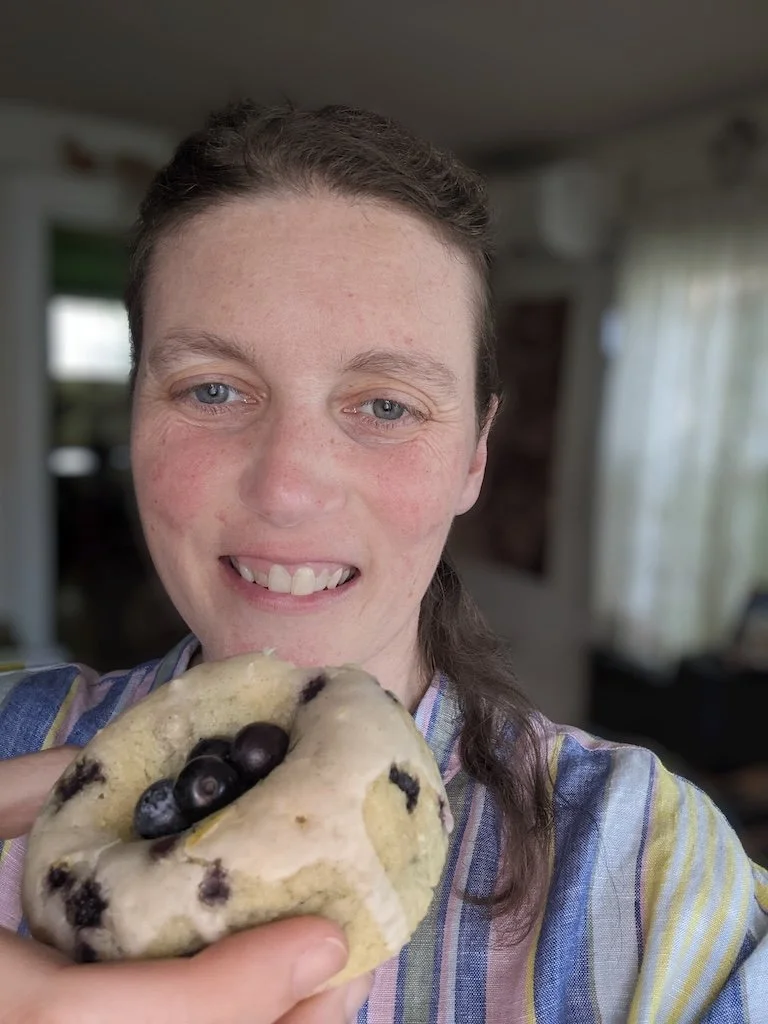
Author Lindsey Britt with a donut from The Mermaid Collective
Like Peruzzi, Peggy Mitchell of soon-to-be-opened Mitchell Delights Eats & Treats in Charlestown, NH brings an omnivore’s perspective to her work in the kitchen. In addition to baking items with animal ingredients, for years she has been selling directly to cafes and has used that opportunity to bake items that happen to be vegan-friendly, but that stay true to the taste and texture of the products she is more accustomed to baking. She points to words of wisdom from her parents that help her keep an open mind: “Don’t knock it till you try it.”
Though it took time and testing to get her vegan-friendly baked goods on par with her other baked goods, Mitchell recommends restaurants and cafes give it a try since they might be surprised by the results. She notes that “at the end of the day, great food should be something everyone can enjoy.”
Peruzzi of Vegan A.F. notes that it can be a strength for a non-vegan chef to engage in serving vegan guests. They may be able to elevate the food by being intimately acquainted with the flavor profiles of food that contains animal products. This can help them recreate those tastes and textures for guests wanting a familiar feel with a twist or for vegans who are looking to gently introduce family and friends to the idea of plant-based food.
One challenge for these small town restaurants is developing a local client base that comes in regularly while also attracting visitors to town who may never have been before, but will hopefully return after a good experience. Many businesses–small and large–find that one way to deal with economic uncertainty is to make sure they are serving the maximum number of guests possible while playing to their strengths.
Lee notes that her guests appreciated the variety on their menu and that there was something for everyone. She made sure the vegan dishes were “thoughtful, purposeful, unlike most places where they seem to be an afterthought.” Similarly Mitchell notes the importance of creating a place where everyone can find something they love, because for her baking has always been about bringing people together. “I want people to feel welcome to explore new flavors and not be afraid to try something different.”
Lindsey Britt is a Vegan Hospitality Consultant with a background in nonprofit administration and vegan baking. She is the founder of Compassionate Dining (compassionatedining.com), which works to inspire people to eat compassionately, sustainably, and healthfully by increasing the availability of plant-based menu options and improving demand for those options through education.